Blessed Are the Peacemakers
Do modern believers model Christ's teaching from the Sermon on the Mount?

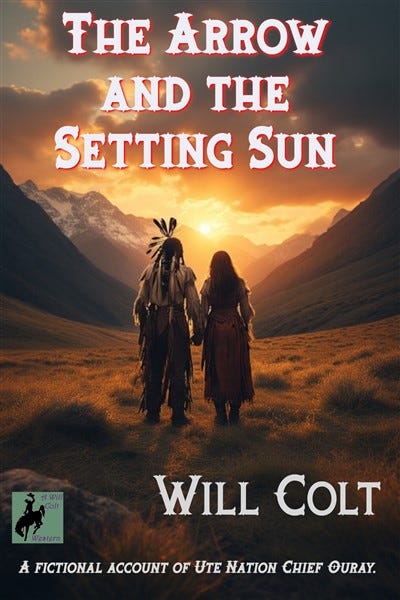
As I was researching and writing my most recent novel, The Arrow and the Setting Sun, something struck me in a powerful way. I want to share it with you, but first, allow me to provide some background.
I grew up in the mountains of Colorado, in the very land where Ouray and the Tabeguache Ute lived. It is a vast and beautiful land full of plenty but also extremely harsh, especially in winter. Looking to and depending on the provision of a gracious creator was a foregone necessity. Our way of life slowly deteriorated under the ongoing suppression of land use laws, environmental activism and economic pressure. Essentially, things you cannot really fight against. I watched our way of life slowly being erased before it finally disappeared in the late nineteen nineties.
Manifest Destiny
Last fall, I was thinking about Manifest Destiny, especially as it relates to Israel’s actions in Gaza and the West Bank. Modern Israel’s claim invokes historical, religious, and security narratives, emphasizing a return to an ancestral homeland. This bears a resemblance to Manifest Destiny, a 19th-century American belief in a divinely ordained right to expand across North America.
Both concepts share a powerful narrative of destiny and a unique claim to territory, justifying settlement and control. Both ideologies undeniably resulted in significant displacement and protracted conflict with existing populations who had their own prior claims and presence in the land. They also ignore the finished work of Jesus Christ, dragging “Christians” back into reapplying the Conquest of Canaan, which was an isolated, God-ordained event in history, not a mandate for our age, the Age of Grace.
With that in the back of my mind, I entered the Historical Novel Society’s First Chapters Literary Competition with a biographical historical fiction piece on Chief Ouray. Rules of the contest prevented me from sharing anything regarding my entry until May of this year, so I set it on the shelf with the opening chapters and an outline.
When I returned to writing The Arrow and the Setting Sun in May, I was struggling with the concept of fully surrendering to Christ. Essentially, I was still not turning over certain areas of my life in full surrender to Christ. At some point in my struggle, the Holy Spirit led me to the Sermon on the Mount as a model for surrender. I’ll share that at a later time because I developed a fascinating understanding of how Christ’s three-chapter sermon is a call to surrender.
When I was deep into the writing and research of The Arrow and the Setting Sun, it suddenly hit me that Chief Ouray, a man who was supposedly a pagan, indigenous leader, perfectly modeled the ideology of Matthew 5:3-9, aka the Beatitudes. Please bear with me as I share what I discovered.
The Quiet Strength of Peacemakers: Chief Ouray and the Beatitudes
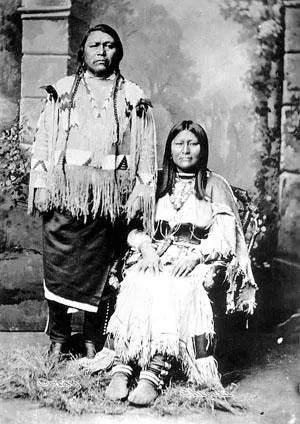
In the annals of history, certain figures stand out not for their military might or their capacity for conquest, but for their profound commitment to peace and their embodiment of quiet strength. Chief Ouray, a principal leader of the Ute people in the 19th century, was one such figure. Sometimes referred to as “The Ute Moses,” Ouray navigated an intensely challenging era, choosing diplomacy and negotiation over war. He consistently advocated for his people through intelligence, patience, and a deep-seated humility. His life, dedicated to peacemaking, offers a striking parallel to Christ’s wisdom in the Sermon on the Mount, particularly Matthew 5:3-9, commonly known as the Beatitudes.
Chief Ouray: A Legacy Forged in Humility and Peacemaking
Chief Ouray inherited leadership during a tumultuous period marked by the relentless westward expansion of the United States driven by the ideology of Manifest Destiny. While many indigenous leaders chose armed resistance against overwhelming odds, a path often leading to tragic outcomes, Ouray uniquely pursued a different strategy. He understood the changing landscape and the immense power disparity, recognizing that the best hope for his people lay in negotiation, even when it meant painful compromises (he eventually gave up the entire state of Colorado).
His approach was far from passive. Ouray was a shrewd negotiator, fluent in English and Spanish, making him an invaluable bridge between his people and the U.S. government. He traveled to Washington, D.C., multiple times, enduring cultural differences and political machinations, all in an effort to secure a future for his people. While he demonstrated immense courage with his own people calling him a traitor, the humility required to sit at the table with those who held the power to dispossess his people, and the unwavering commitment to a peaceful resolution was a significant burden. His life was a testament to the belief that peace, even imperfect peace, was preferable to continued conflict and annihilation.
Echoes of the Beatitudes in Ouray’s Leadership
The Beatitudes, delivered by Jesus in Matthew 5:3-9, lay out a spiritual framework for blessed living, emphasizing humility, compassion, and peacemaking. These are radical concepts in our modern world, and we tend to ignore them as a profound spiritual teaching rather than something we ought to practice in our daily living, but let’s get back to Ouray.
When we compare Ouray’s leadership with these spiritual principles, a profound connection emerges:
“Blessed are the poor in spirit, for theirs is the kingdom of heaven.” (v.3): Ouray recognized the vulnerability of his people and the limits of their power against an encroaching nation. This “poverty in spirit” wasn’t a lack of spirit, but a realistic assessment of their situation, leading him to seek non-violent solutions rather than futile confrontation. Consider Matthew 5:23-26.
“Blessed are those who mourn, for they will be comforted.” (v.4): Ouray undoubtedly mourned the loss of ancestral lands and the erosion of Ute traditions. Yet, in his steadfast commitment to securing a future, there was a profound hope for comfort and eventual restoration for his people, even if it came in a new form.
“Blessed are the meek, for they will inherit the earth.” (v.5): This Beatitude resonates deeply with Ouray. He did not seek to violently assert dominance but operated with a quiet, persistent strength. His “meekness” was not weakness, but a strategic humility that aimed to preserve a portion of what was rightfully his people’s, ensuring their continued existence on the land.
“Blessed are those who hunger and thirst for righteousness, for they will be filled.” (v.6): Ouray relentlessly pursued what he believed was right for his people, even in the face of systemic injustice. His negotiations, often frustrating and imperfect, were driven by a hunger for a just outcome, for recognition of the rights of his people, and for a path forward built on integrity.
“Blessed are the merciful, for they will be shown mercy.” (v.7): Engaging with a government that often showed little mercy, Ouray himself extended a form of mercy by always seeking negotiation over retribution. His willingness to build trust, however fragile, was an act of profound compassion.
“Blessed are the pure in heart, for they will see God.” (v.8): Ouray’s motivation was consistently for the welfare and survival of his people. His intentions were clear and unwavering, free from personal ambition or vengeance, purely focused on their enduring good.
“Blessed are the peacemakers, for they will be called the sons of God.” (v.9): This is Ouray’s defining characteristic. He was the quintessential peacemaker, actively mediating, building bridges, and preventing further bloodshed. His tireless efforts in an era of conflict truly embody the spirit of this Beatitude, marking him as a leader whose legacy is one of reconciliation and human dignity.
An Enduring Message
Chief Ouray’s life offers a powerful, historical illustration of the principles articulated in Matthew 5:3-9. His humility in the face of overwhelming power, his unwavering commitment to diplomacy, and his profound capacity for peacemaking demonstrate that true strength often lies not in aggression, but in wisdom, patience, and compassion. In a world still grappling with conflict, the wisdom of Chief Ouray and the timeless truths of the Beatitudes remind us that the path of humility and peace is not just a spiritual ideal, but a powerful, practical strategy for survival, justice, and lasting well-being.
But There’s More
I was dumbfounded by the fact that a pagan so expertly modeled Christlikeness when so many in our modern “Christians” are among the most vocal war hawks, not only advocating for Israel’s expansionism but DEMANDING that we help fund it.
Does that BOTHER you?
Where are the Beatitudes of Christ in those who claim to be His followers?
How can a “pagan Indian” more expertly demonstrate them than men who are supposed to have great biblical understanding?
So, I did some more digging. Ouray, at a very young age, after his mother died giving birth to a younger brother, was taken to Taos, New Mexico, where he was raised by Franciscan friars. There is not much written about his time there. We know that he learned English and Spanish while he was there. I think that there is a very good chance that he was exposed to the Beatitudes and returned to them at some point later.
Ouray the Warrior Became Ouray the Peacemaker
Ouray was a fierce hunter and warrior, feared by other indigenous people, but something changed in him, maybe after his son was taken by the Lakota while the Tabeguache were hunting buffalo on Colorado’s Eastern plains, sometime in about 1862. It’s only speculation. By 1868, when Ouray was 35-years-old, he had already taken on the attitude of a peacemaker because he negotiated turning over the land of the Tabeguache east of the Continental Divide, giving up one of their most sacred mountains, Pike’s Peak.
The pattern after that first concession remained the same throughout his life, and he was still trying to broker peace on behalf of the Southern Ute Nations, not his own people, when he died of Bright’s Disease at age 47.
Was Ouray a Believer?
Then, I found another jewel of history, hidden as most things of its kind are hidden. It turns out that in his last several years, Ouray had become a devout Methodist. That doesn’t mean a lot in our day and age, but Ouray died in 1880. In the 1870s, Methodists were known for a dedication to temperance and moral discipline, which included methodical study of the scriptures, and evangelical worship.
No one can determine whether another person is “born again,” though the scriptures teach us that we will be known by our fruit. Did Ouray model the principles of Christ’s sermon because he was following the example of His Lord?
How Does This Apply to Today?
The United States, in 2026, just like it was in the mid-1800s, is being led by false teaching and false teachers. Our participation in Israel’s Manifest Destiny is CONTRARY to the teachings of our Lord. Maybe it requires the example of a “pagan Indian” to get American “Christians” back to their FIRST LOVE (Rev. 2:4).
The Arrow and the Setting Sun demonstrates the heart of a peacemaker. If you want to be stirred into standing among the Sons of God (Matt. 5:9), consider picking up a copy today. Besides delivering a profound message, it helps support my family.
The Arrow and the Setting Sun: Available August 3rd, 2026. Advanced reading copies for those who wish to write a review are currently available. Contact me for more information.